
Digital transformation is essential for modern businesses, but many organizations still struggle with digital transformation failure due to poor planning, weak leadership, outdated legacy systems, and ineffective change management.
The question isn’t whether to transform; it’s how to do it without joining the majority that fail.
Based on widely cited industry research and proven success frameworks, here’s exactly why these projects fail and what you can do to prevent it.
What Is Digital Transformation and Why Is It Important?
Digital transformation isn’t about buying new software. Successful businesses start with a clear strategy and the right Digital Transformation Services.
Key Distinctions:
Term | Definition | Example |
Digitization | Converting analog information into digital formats | Scanning paper records to PDFs |
Digitalization | Using technology to improve existing processes | Automating email approvals with workflow tools |
Digital Transformation | Reimagining business models and operations | Shifting from product sales to subscription-based digital services |
In 2026, transformation touches four areas simultaneously:
- Legacy systems evolving to cloud platforms
- Manual tasks transitioning to AI automation
- Gut instinct decisions becoming data-driven
- Organizational silos transforming into agile operating models
The digital transformation success framework starts with understanding that transformation is a journey, not a destination. Companies that treat it as a one-time project with an end date consistently fail.
Digital Transformation Success Framework: The 3-Pillar Model
Failures rarely stem from a single issue. They cascade across three interconnected pillars:
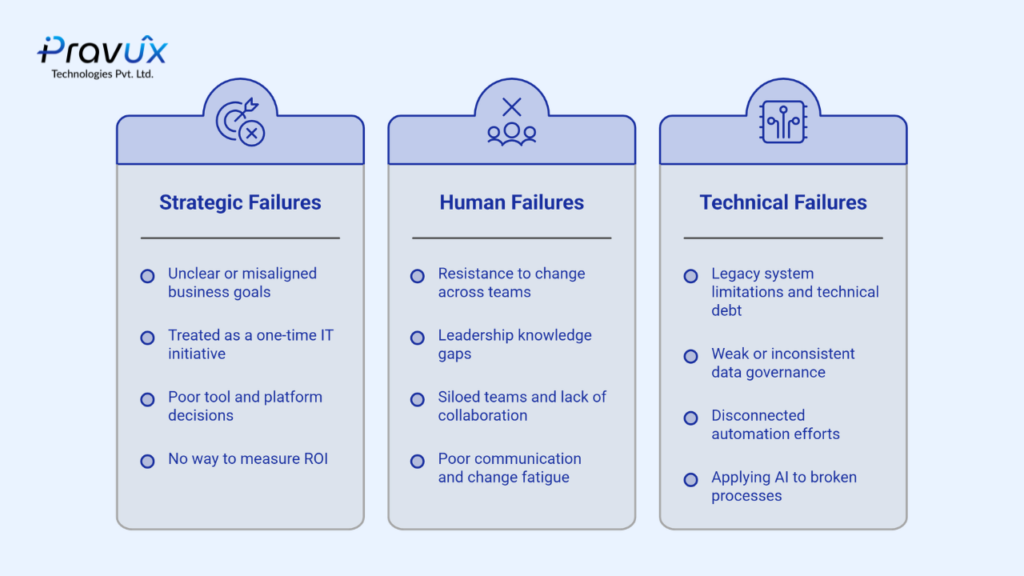
Top 12 Reasons Why Digital Transformation Projects Fail in 2026
Understanding why digital transformation projects fail is the first step toward building a successful digital transformation strategy.
Strategic Failures
1. No Clear, Measurable Business Goals
Vague goals like “improve efficiency” set up projects for failure. Without KPIs, teams can’t track progress, align priorities, or prove ROI.
The Fix: Define outcome-driven KPIs with:
- A clear baseline (current state)
- A measurable target (desired outcome)
- Ownership (who’s responsible)
- A defined timeline
Example: Reduce invoice processing time from 10 days to 3 days within 6 months, with named ownership and measurable milestones.
2. Choosing the Wrong Technology
Organizations pick up trending tools without asking: “Is this right for our processes, people, and data?”
Common symptoms include:
- Integration issues post-implementation
- Employees creating workarounds
- Vendor lock-in and unexpected costs
The Fix: Before choosing, ask:
- Will it work with our current systems?
- Is it secure and compliant?
- What is the real total cost?
- Can our team use it easily?
- Can we rely on the vendor for the long term?
3. Treating Transformation as a One-Time IT Project
Digital transformation is an ongoing journey, not a project with an end date. Companies that “launch and move on” end up with modern tools but outdated processes.
The Fix: Set up quarterly Digital Transformation Reviews to:
- Track progress against KPIs
- Identify gaps and improvement areas
- Update the roadmap
- Approve the next phase
4. Lack of Executive Alignment and Sponsorship
Leaders may approve budgets but fail to understand what transformation truly requires. A structured business consulting approach helps align technology investments with business goals.
The Fix: Run a focused executive workshop to:
- Clarify what transformation needs beyond tools
- Define clear goals with measurable KPIs
- Set ownership and accountability for each leader
5. Unrealistic Timelines and Budget Models
Most successful initiatives require 12-24 months in phases, not a few months. When leaders expect quick results or approve only tech budgets, projects fail.
The Fix:
- Plan for the full cost (tools, integration, training, change management)
- Add a 15–20% buffer for unexpected issues
- Allow 25% more time than vendor estimates
Human Failures
6. Resistance to Change and Change Fatigue
People don’t resist change; they resist uncertainty, overload, and lack of support. When too many tools roll out too fast, adoption drops.
Warning signs include:
- Low training participation
- Employees reverting to spreadsheets
- Comments like “not another new system”
- Unofficial workarounds
The Fix:
- Roll out changes in phases
- Offer role-based training
- Identify 2 change champions per team
- Recognize small wins to build momentum
7. The Shadow IT Problem
When official systems are hard to use, employees find unofficial alternatives, creating security risks, and masking real adoption.
The Fix:
- Design solutions with users, not just for them
- Focus on ease of use from day one
- Solve real workflow problems, not just deploy tools
8. Siloed Teams and Fragmented Communication
When departments operate in silos, systems never fully connect. IT builds, others don’t use, and data becomes inconsistent.
The Fix: Create a cross-functional transformation team:
- Include representatives from each key department
- Assign a clear executive sponsor
- Define shared goals and responsibilities
- Meet monthly to make decisions
9. Insufficient Skill Development and Training
Introducing new technology without training leads to low productivity, mistakes, and reversion to old tools.
The Fix:
- Provide role-based training
- Create a safe test environment for practice
- Run monthly support sessions
- Train power users in each team
Technical Failures
10. Legacy System Debt
Modernizing legacy infrastructure with scalable Cloud Services helps businesses improve performance, security, and long-term scalability.
The Fix:
- Calculate annual maintenance costs
- Estimate delays caused by integration challenges
- Show total cost as business impact
11. Poor Data Governance and Integration
Unreliable data makes every system built on top of it unreliable reports, dashboards, AI, everything.
The Fix:
- Assign a clear owner for each key data area
- Define what each data point means across systems
- Clean and validate critical datasets
- Check data readiness before launching new tools
12. Siloed Automation vs. Connected Workflows
Automating individual tasks instead of full processes creates “automation islands” where handoffs remain in manual.
The Fix:
- Map key processes end-to-end
- Identify where work moves between systems and teams
- Automate handoffs, not just steps
- Connect systems for smooth flow
Early Warning Signs Your Digital Transformation Is Failing
Spot these signs your digital transformation is failing in the first 6 months to prevent full-scale failure:
- Frequent changes in project scope or goals
- Low user adoption at 30, 60, or 90 days
- Poor alignment between IT and business teams
- Budget overruns exceeding 20–25%
- Employees reverting to old workflows
- Declining team morale around digital initiatives
- Rise of Shadow IT
- No measurable ROI within 6–12 months
Recognizing these legacy system modernization challenges early helps you course-correct before failure becomes inevitable.
AI Challenges in Digital Transformation
Businesses should first establish a strong digital foundation before investing in AI-powered solutions.
- Using AI without fixing data quality
- Choosing AI tools before defining problems
- No clear ownership for AI outputs
- Expecting AI to fix messy processes
The Right Approach:
- Start with a clear business problem, not a tool
- Clean and prepare data before using AI
- Add human review where AI impacts decisions
- Measure success based on usage and output quality
The 6 Step Fix Framework for Digital Transformation Success
Follow this structured digital transformation success framework to prevent failure:
Phase | Action | Key Deliverable |
Week 1 – 2 | Set clear business goals and KPIs | 3 – 5 measurable outcomes with owners |
Week 2 – 4 | Select 1 – 2 high-value use cases | Pilot with defined success criteria |
Month 1 | Build the right team and governance | Executive sponsor, product owner, change lead |
Month 2 – 4 | Pilot, test, and measure | Adoption rate, KPI improvement |
Month 3 – 5 | Drive adoption with training | Role-based training, communication plan |
Ongoing | Review, optimize, scale quarterly | Quarterly KPI reviews, roadmap updates |
Digital Transformation KPIs You Should Track
Measure progress across four categories to avoid becoming another digital transformation failure statistic in 2026:
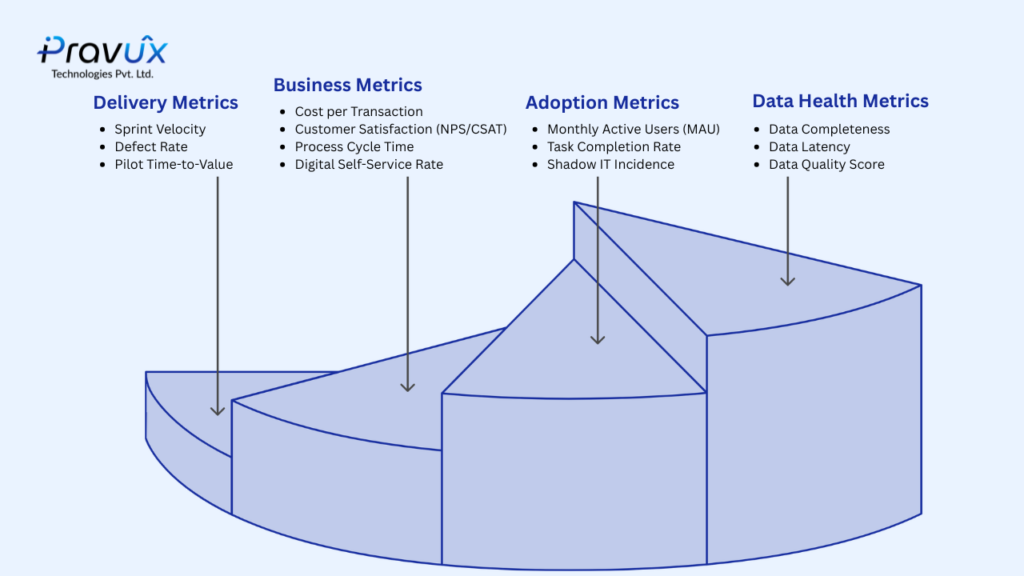
These digital transformation KPIs provide early warning signals and help you stay on track.
How to Avoid Digital Transformation Mistakes: A Prevention Checklist
Before launching, ensure:
- 3–5 clear business outcomes with named owners
- Each outcome has a KPI, baseline, and target
- End users involved in defining requirements
- Data owners assigned to all critical entities
- Role-based training planned before go-live
- Budget includes integration, change management, support
- Contingency plan for delays and rollback
- Executive sponsor participates in cross-functional reviews
- Technology selection based on structured evaluation
- Quarterly reviews scheduled for continuous improvement
This checklist directly addresses how to avoid digital transformation mistakes before they derail your project.
Real-World Failure Examples and Lessons
1. GE Predix (Strategy Failure)
GE invested heavily in Predix, its industrial IoT platform, but the initiative struggled due to an overly broad vision, unclear focus, and weak adoption across business units, and the company was ultimately forced to scale back the effort significantly.
The Lesson: Start with a smaller, well-defined use case, not a platform for everyone.
2. Ford Smart Mobility (People and Structural Failure)
In 2016, Ford launched Ford Smart Mobility to pivot toward autonomous vehicles, ridesharing, and connected services. Rather than integrating the initiative into core operations, the unit was run as a physically and organizationally separate entity. The division reported roughly $300 million in losses by 2017, and Ford’s CEO stepped down that same year amid falling stock performance.
The Lesson: Transformation efforts fail when they’re isolated from the core business, and the culture isn’t brought along. Structural separation without organizational alignment amplifies resistance rather than reducing it.
How to Recover a Failed Digital Transformation Project
If your project is already failing, don’t panic. Here’s a 5-step recovery plan:
- Stabilize immediately – Pause new changes, assign clear owners, focus on one KPI
- Audit the current state – Find what’s working versus what’s broken
- Refocus on goals – Keep only what matters, make goals measurable
- Stay flexible – Shift to agile, short cycles, learn quickly
- Fill capability gaps – Bring in the right expertise
How to Avoid Digital Transformation Failure in 2026
Digital transformation failure remains a persistent challenge in 2026. A figure of roughly 70% is widely cited across industry research from firms like McKinsey and BCG, though estimates vary depending on methodology and industry. Whatever the precise number, the pattern is consistent: most initiatives underdeliver, and your project doesn’t have to join that statistic.
Success isn’t about having the best technology; it’s clear goals, strong governance, and people-first adoption strategies.
The organizations that succeed don’t have better tools. They have better planning, better communication, and better execution.
Digital transformation success is not about adopting the latest technology, it’s about creating the right strategy, empowering people, and continuously improving processes. By following proven digital transformation best practices, tracking the right KPIs, and avoiding common digital transformation mistakes, organizations can significantly increase their chances of long-term success.