
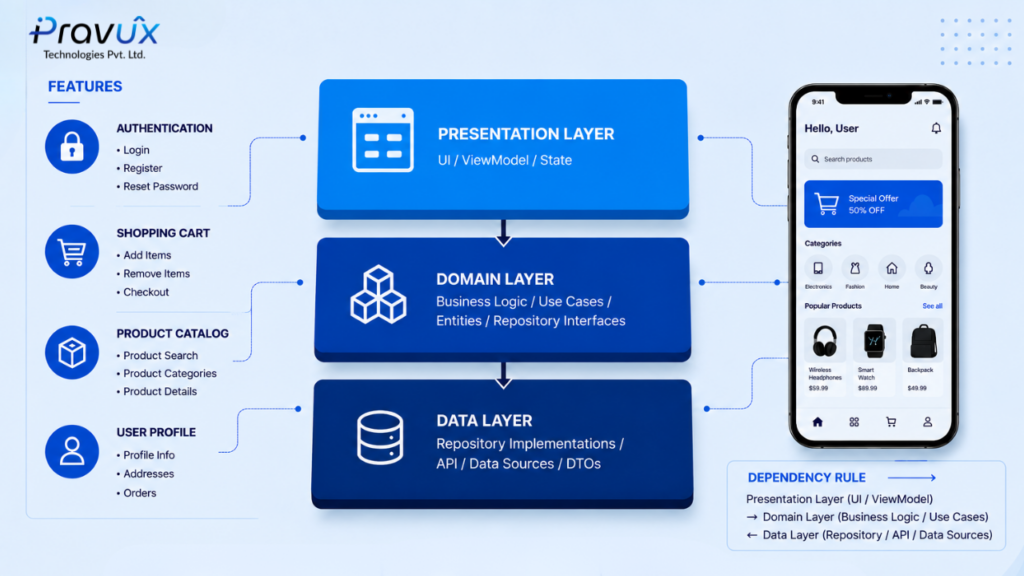
This approach organizes code by business feature (e.g., authentication, shopping_cart) rather than by technical type (e.g., all screens together, all models together). Each feature is self-contained and follows a strict three-layer separation Presentation (UI/ViewModels), Domain (pure business logic/entities), and Data (APIs, databases, DTOs) connected by a unidirectional dependency rule where Presentation and Data both depend inward on Domain, but never the reverse.
Monolithic folder structures, where code is grouped globally by technical type (e.g., putting all screens in one massive ui directory and all models in a shared models folder) completely break down when an application scales. As teams grow, this layout leads to massive git merge conflicts, tight class coupling, and heavy cognitive load when onboarding new developers.
For enterprise-grade scalability, modern production apps rely on Feature-First Clean Architecture. This pattern slices your app vertically by business domains rather than horizontally by technical layers. Each feature functions as an independent, self-contained module that implements a strict Model-View-ViewModel (MVVM) separation pattern.
The Modular Directory Layout
In a Feature-First system, the codebase is anchored by two root directories: core (for shared code like design systems, network engines, and universal utilities) and features (for independent user capabilities).
Every single capability within the app (such as authentication, shopping_cart, or product_feed) encapsulates its own localized data handles, business logic rules, and UI layouts:
Plain Text
lib/
├── core/                      # Shared infrastructure global modules
│   ├── network/               # Centralized HTTP/Dio client configurations
│   ├── theme/                 # Design system tokens, typography, and color schemes
│   └── utils/                 # Extension methods and global helper functions
└── features/                  # Vertical business capability modules
    ├── authentication/
    │   ├── data/              # DATA LAYER: API drivers, local databases, and DTOs
    │   │   ├── datasources/   # Remote and local data fetchers
    │   │   ├── models/        # JSON serialization Data Transfer Objects (DTOs)
    │   │   └── repositories/  # Concrete repository implementations
    │   ├── domain/            # DOMAIN LAYER: Pure logic, entities, and interfaces
    │   │   ├── entities/      # Clean, immutable business data models
    │   │   ├── repositories/  # Abstract repository contracts
    │   │   └── usecases/      # Single-responsibility business rules
    │   └── presentation/      # PRESENTATION LAYER: UI components and controllers
    │       ├── controllers/   # ViewModels or State Management Notifiers
    │       ├── screens/       # Main entry point view widgets
    │       └── widgets/       # Localized, single-use visual subcomponents
    └── shopping_cart/         # Independent cart domain workspace
The Unidirectional Dependency Rule
To prevent structural architecture rot, dependencies must follow a strict, unidirectional path. High-level user interface elements must never speak directly to low-level data frameworks. The dependency structure flows inwards:
$$\text{Presentation Layer (UI/ViewModel)} \longrightarrow \text{Domain Layer (Logic/Contracts)} \longleftarrow \text{Data Layer (Infrastructure)}$$
1. The Presentation Layer (The Visual Shell)
The presentation layer is responsible entirely for visual layout rendering and translating hardware inputs into execution triggers.
Views (Screens & Widgets): Declarative widget trees that render state onto the canvas. They contain zero logical operators, string manipulations, or mathematical formulas. They listen to the controller and draw pixels accordingly.
ViewModels / State Controllers: Manage the UI view state (e.g.,
loading,success,error). They map user gestures to specific business use cases and format raw data fields into clean, human-readable display values.
2. The Domain Layer (The Core Brain)
The domain layer is the absolute core of the application module. It must be written in pure Dart, completely independent of third-party plugins, caching libraries, external API schemas, or even the Flutter framework itself (flutter/material.dart).
Entities: High-level, immutable business models. They reflect the actual domain models required by the product, fully divorced from how a backend database stores or structures them.
Repository Interfaces: Abstract contracts that define the required data operations (e.g.,
Future<User> getUser(String id);). They dictate what data the feature needs without caring how it is fetched.Use Cases: Single-responsibility logic executors. For instance, a
LoginWithEmailuse case validates strings and coordinates password encryption steps before sending data downstream.
3. The Data Layer (The Infrastructure Engine)
The data layer satisfies the contracts defined by the domain layer. It handles all raw external input/output communication.
Data Sources: Low-level network wrappers or local database handles (
Dio,Supabase,Isar,Drift). They capture raw JSON strings or database rows.Data Transfer Objects (DTOs): Serialization models that map data directly to outside schemas. They include explicit JSON parsing code (
fromJson,toJson) and include a.toEntity()mapper method to transform themselves into clean domain entity objects.Repository Implementations: The Single Source of Truth (SSOT) for your data pipeline. They implement the domain’s abstract repository interfaces, managing internal caching strategies and choosing whether to serve local database profiles or execute live remote API queries.
Why This Architecture Wins at Scale
When multiple engineering squads are working on a massive application, this structural pattern delivers distinct engineering benefits:
Isolated Regression Risks: If an engineer alters a data model or database engine inside the
authenticationfolder, theshopping_cartorproduct_feedcode remain isolated, preventing cascading compilation failures.High Unit Testability: Because the domain layer relies strictly on abstract interfaces rather than raw HTTP clients, developers can mock out repositories instantly. This makes writing isolated unit tests for pure business logic trivial, without needing to run expensive widget pumps or integration environments.
Zero-Friction Git Workflows: Teams work inside distinct directories, drastically minimizing overlapping changes to the same configuration lines and eliminating daily git merge conflict bottlenecks.
Scale & Structural Verification Checklist
Ensure your automated deployment pipelines test and enforce these architectural boundaries on every single commit:
[ ] Pure Domain Layers: The
domain/directory must not contain imports to third-party data packages (dio,isar) or the main UI toolkit (package:flutter/material.dart).[ ] Bounded Interfaces: Presentation layers must interact strictly with abstract repository interfaces or use cases, never directly instantiating concrete data implementations.
[ ] Data Model Separation: API network responses must never be used directly inside UI widgets. They must map down to clean, presentation-safe domain entities first.
Conclusion:
As applications and teams grow, Feature-First Clean Architecture prevents the merge conflicts, tight coupling, and onboarding friction typical of monolithic folder structures. By isolating features into independent modules with clear layer boundaries, teams gain:
Isolated regression risk — changes in one feature don’t cascade into others
High testability — pure domain logic can be unit-tested without UI or network dependencies
Smoother git workflows — parallel development across teams with minimal file overlap
Enforcing this structure (e.g., via a verification checklist banning Flutter/third-party imports in the domain layer) keeps the architecture resilient and scalable over the long term.