
Every product team knows the challenge: as a product grows, development becomes slower and more complex. This is common in modern software development and product development. Teams must manage existing code, technical debt, integrations, testing, security, customer expectations, and technical dependencies. As a result, the software development process requires more planning, collaboration, and approvals.
It can feel like the team lost its edge. Usually, that isn’t what happened. What changed is the environment around the team. The first launch happens when the system is simple: little legacy code, limited customer data, few stakeholders, few dependencies, and low risk if something goes wrong. After launch, every new feature is built on top of something that already exists, and that’s where complexity begins.
Development doesn’t slow because people work less. It slows because more of the team’s effort now goes toward coordinating, validating, maintaining, and protecting what’s already been built. This post walks through why that happens and what teams can actually do about it, not by recreating early-stage chaos, but by building a system that can move quickly despite complexity.
The Myth of Linear Progress
Early product development creates a tempting assumption: if the first feature shipped fast, later features should ship even faster since the team has now “learned how to work together.” Sometimes that holds for a while, but software development rarely scales linearly.
The first feature usually has almost no constraints: no legacy behavior to preserve, no customer workflows to protect, no other teams touching the same code. Every feature after that inherits the decisions that came before it. The codebase has opinions, the database holds real data, APIs have real consumers, and customers have real expectations. The product has stopped being a blank canvas, which isn’t a bad thing, but it is the natural cost of becoming a real product.
12 Reasons Development Slows After Launch
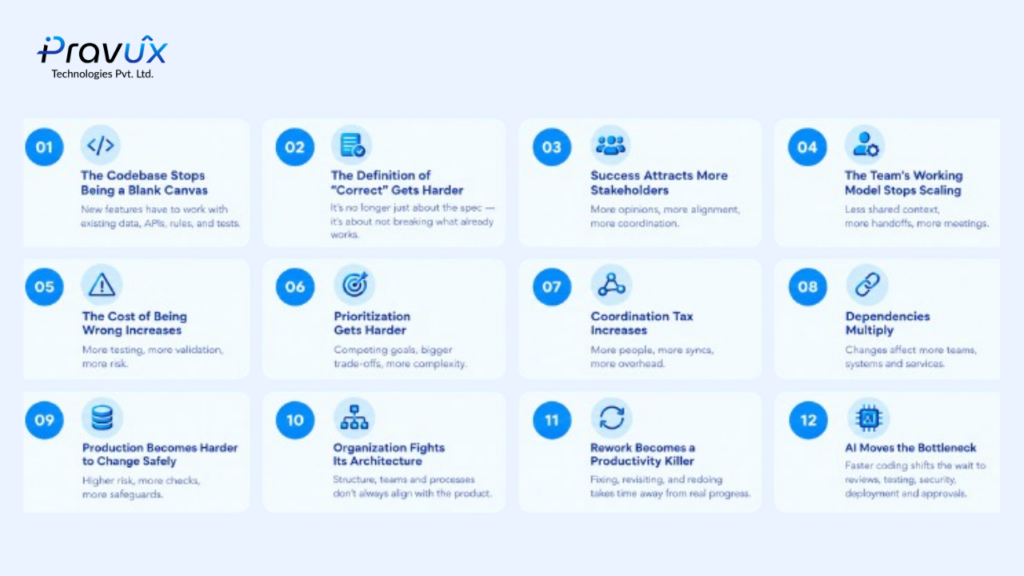
1. The Software Development Codebase Stops Being a Blank Canvas
The first feature is written into a near-empty codebase with few dependencies and few ways for one change to break something else. Over time, the codebase develops structure, and new functionality has to work with existing data models, APIs, business rules, integrations, and tests, not in isolation.
Example: Adding one field to a customer profile can require a schema change, API updates, new validation, backend and frontend changes, updated queries, updated analytics, new tests, and a backward-compatibility check.
Technical debt becomes expensive not because the original decisions were wrong, but because every fast decision made early creates future interest that has to be paid eventually. The goal isn’t to eliminate debt; that’s unrealistic. The goal is to name it explicitly, measure its impact, and pay down the pieces actively slowing the team down.
2. The Definition of “Correct” Gets Harder
Before launch, correctness is a design decision. After launch, it becomes a negotiation between product intent, existing behavior, real user behavior, technical constraints, and business requirements. A pre-launch feature just has to match the spec. A post-launch feature has to match the spec without unexpectedly breaking what already works, which introduces backward compatibility as a permanent constraint.
Customers depend on existing workflows. Other systems depend on existing APIs. Analytics depends on existing event structures. The team is no longer only asking “can we build this?” It also has to ask “what else could this change affect?” and that second question is one of the hidden costs of product maturity that rarely shows up on a roadmap.
3. Success Attracts More Stakeholders
A successful feature attracts attention. Sales want to know what customers are asking for next. Customer success wants improvements that reduce ticket volume. Marketing wants capabilities that strengthen positioning. Leadership wants to protect something that’s become strategically important. Security and legal get involved as usage and risk scale. Finance starts asking about the cost of running it.
None of these stakeholders are wrong to care if their concerns are legitimate. The problem is that each additional stakeholder adds coordination overhead to every decision. What used to be a two-person conversation between product and engineering can become an eight-person conversation involving design, sales, customer success, security, legal, and leadership. That doesn’t necessarily produce worse decisions, but it reliably produces slower ones.
Fix: Create clear decision ownership and structured moments for stakeholder input, rather than letting everyone weigh in continuously and informally.
4. The Team’s Working Model Stops Scaling
Early teams run on shared context. Everyone remembers why a feature exists; everyone knows the shortcuts that were taken, and informal communication is extremely efficient because nobody needs it explained. But teams grow, new engineers, new PMs, new designers, sometimes distributed across locations, specifically because the company wants to build on its early success.
The information that used to live only in people’s heads now has to live somewhere else: documentation, onboarding materials, architecture decisions, product requirements, design systems, runbooks, coding standards, and clear definitions of ownership. Without these, software development teams repeatedly rediscover the same information, work gets duplicated, decisions become inconsistent, and the organization becomes dangerously dependent on the few people who still hold the tribal knowledge.
Documentation stops being an administrative afterthought and becomes productivity infrastructure the thing that lets a growing software development team actually move faster instead of just moving louder.
5. The Cost of Being Wrong Goes Up
When a product has no users, a bad decision is cheap: build it, learn, change it. After launch, the blast radius of a mistake is much larger: customer churn, support tickets, negative reviews, data problems, revenue loss, production incidents, security exposure, even contractual issues.
Naturally, teams become more careful: more tests, more reviews, more validation, more monitoring. This isn’t a loss of startup energy, it’s a rational response to higher stakes. The real mistake is expecting a mature, revenue-generating product to move with exactly the same process that worked before there were any customers to disappoint. The operating model has to evolve alongside the risk, and organizations that don’t acknowledge this tend to blame the team for “getting slow” instead of recognizing that carefulness has a legitimate cost.
6. Prioritization Gets Genuinely Harder
Before launch, there’s usually one dominant priority: ship the product. After launch, the roadmap forks into customer requests, bugs, technical debt, performance problems, infrastructure work, new features, experiments, security requirements, and strategic initiatives, and almost all of it can sound important.
This creates a specific failure mode: work starts faster than it finishes. A feature starts, then a customer escalation interrupts it, then a production issue pulls the team away, then a leadership request starts a new thread, and eventually the organization has many things in progress but surprisingly few things completed.
A framework like RICE (Reach, Impact, Confidence, Effort) can help compare competing opportunities, though no framework replaces judgment. The core principle that matters most: reduce the number of things competing for the team’s attention at the same time.
7. Coordination Tax Starts Eating Engineering Time
A feature that once required one engineer can, as the product grows, require frontend engineering, backend engineering, database changes, QA, design, analytics, DevOps, security review, and product approval. The amount of code hasn’t necessarily grown that much; the number of interactions required to ship it has. This coordination tax quietly becomes one of the largest reasons software development slows down, even as headcount grows.
Fix: Reduce unnecessary dependencies through clear ownership, well-defined interfaces between systems, smaller teams, self-service tooling, reusable platform capabilities, and smaller feature boundaries, so the common path requires fewer conversations by default.
8. Dependencies Multiply
A mature product rarely consists of isolated features, everything connects to something else. A single new feature might depend on a chain running from frontend to API to service to database to an external provider to analytics to a notification system. If several teams touch different links in that chain, a technically simple feature becomes organizationally complex.
This is why software architecture and team structure matter more as a company grows. Conway’s Law observes that a system’s structure tends to mirror the communication structure of the organization that built it. If every small feature requires coordination across five teams, the architecture will eventually reflect those organizational seams, for better or worse. Reducing unnecessary cross-team dependencies tends to improve both the architecture and the delivery speed at the same time.
9. Production Systems Become Harder to Change Safely
Before launch, you can restart the application whenever you like. After launch, you have users, and that changes everything. Production systems need monitoring, logging, alerting, backups, rollback strategies, migrations, observability, and incident response. Deployment itself becomes part of the product.
This is why mature teams need to think about change safety, DevOps, and not just development speed. A team that ships quickly but frequently breaks production isn’t actually fast, it’s generating rework. Modern DORA research separates delivery into throughput and stability, using metrics like:
- Change lead time
- Deployment frequency
- Failed-deployment recovery time
- Change-fail rate
- Deployment rework rate
That framing is useful because it reorients teams away from “maximum number of releases” and toward “fast delivery and stable delivery.”
10. The Organization Starts Fighting Its Own Architecture
As companies grow, they reorganize: one team becomes two, two become five, the product gets divided into domains, and ownership shifts. But the architecture doesn’t always evolve at the same pace. Eventually organizational boundaries and technical boundaries stop matching: one team owns the frontend, another the API, another the database, another infrastructure, and a single customer-facing feature now has to cross all four, creating handoffs, and handoffs create waiting.
The answer isn’t automatically microservices, which can introduce their own operational and coordination overhead. The deeper principle is aligning team ownership, business capabilities, and technical boundaries wherever practical, using Conway’s Law, and its inverse, as a lens for deliberately designing organization and architecture together rather than letting one drift away from the other.
11. Rework Becomes the Hidden Productivity Killer
A team can look extremely busy while making very little net progress, because a large share of its work is being redone. A requirement changes mid-build. A feature gets built on a wrong assumption. A deployment introduces a bug. A migration fails. The design changes late. A dependency isn’t ready. A customer escalation interrupts the project, and the team spends another week fixing work that was already considered finished.
This is dangerous specifically because traditional productivity measures, tickets closed, story points, can hide it entirely. A team can close a large volume of tickets while spending a meaningful chunk of its time fixing its own previous output. This is part of why modern delivery measurement looks at both throughput and instability; DORA’s deployment rework rate metric exists specifically to capture unplanned deployments made to fix user-facing bugs. The real goal was never to maximize output; it’s to maximize finished, valuable output.
12. AI Makes Coding Faster but Doesn’t Remove the Bottleneck
AI-assisted software development introduces a new version of the same underlying problem. If AI makes writing code faster, the bottleneck simply moves somewhere else: to code review, architecture decisions, testing, security sign-off, deployment, debugging, requirements clarity, integration work, or stakeholder approval.
Faster code generation doesn’t automatically mean faster product delivery. AI can improve local productivity while leaving system-level productivity unchanged. The useful question isn’t “how fast can we write code?” it’s “where is work actually waiting?” That’s the bottleneck worth fixing in modern software development.
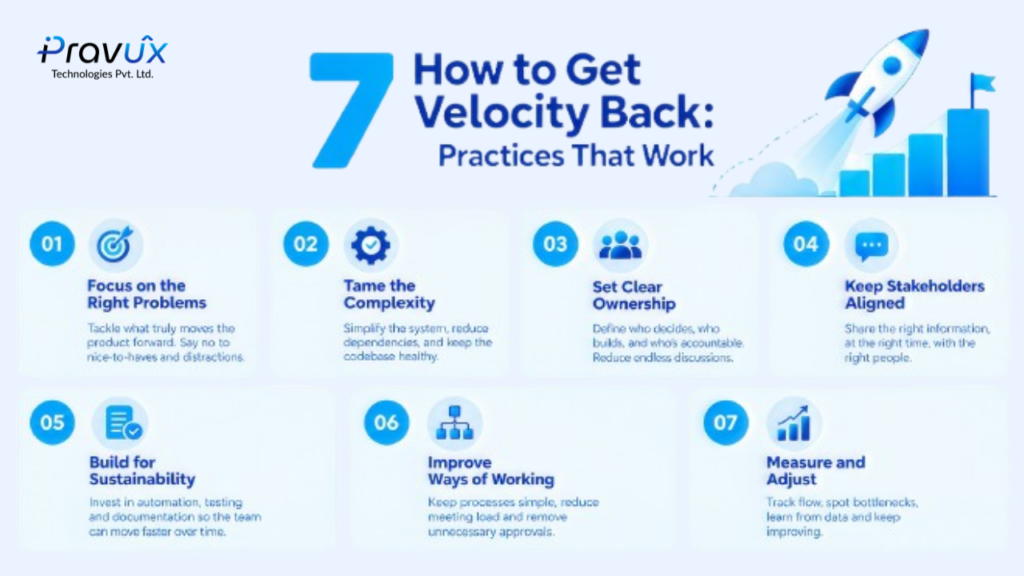
How to Get Velocity Back: 7 Practices That Work
The answer isn’t eliminating process, it’s eliminating unnecessary friction. These software development best practices consistently help teams improve delivery velocity:
- Treat technical debt as planned work, not an emergency fund.
- Reduce batch size.
- Make ownership explicit.
- Build self-service paths.
- Separate reversible and irreversible decisions.
- Protect focus time.
- Measure the delivery system, not just individual output.
A Practical Post-Launch Operating Model
A healthy post-launch team can think about its capacity across four categories:
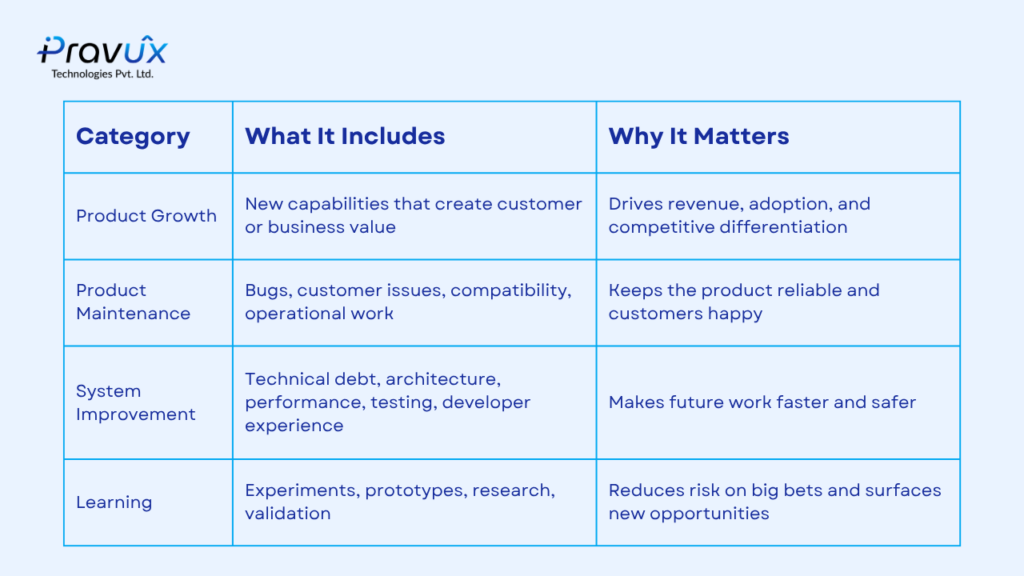
The right split will vary by product and maturity, but all four need to be treated as legitimate, budgeted work. If everything is treated as a feature, maintenance and system improvement stay invisible until they become emergencies.
The Real Definition of Velocity Changes
Early-stage velocity usually means “how quickly can we build something?” Mature-product velocity should mean “how quickly can we move a valuable change safely through the entire system,” idea, decision, design, development, review, testing, deployment, monitoring, and learning, end to end.
- If development speeds up, but review slows down, overall velocity hasn’t actually improved.
- If deployment gets faster, but incidents increase, velocity may have quietly gotten worse.
- If engineers write code faster but spend more time waiting on decisions, the organization’s real bottleneck never moved.
This is why velocity, after the first launch, is a property of the whole system, not just of engineering.
Conclusion
The slowdown after the first big feature launch isn’t a mystery. It’s what happens when a product moves from a relatively unconstrained environment into a real operating system of code, customers, dependencies, stakeholders, and organizational complexity. The first launch is fast largely because there’s so little to coordinate. Every launch after it is harder, because there’s so much more to protect, understand, and integrate.
That doesn’t mean teams have to accept permanent slowdowns. The best teams evolve their operating model instead of fighting it: they manage technical debt before it becomes crippling, reduce unnecessary dependencies, make ownership clear, automate repetitive work, ship in smaller batches, distinguish high-risk decisions from reversible ones, and measure both throughput and stability.
For organizations working with a software development company, the same principle applies: sustainable product velocity comes from building a development system that balances speed, quality, scalability, security, and long-term maintainability.
Most importantly, teams should stop asking only, “why aren’t developers moving faster?” and start asking, “where is the system making valuable work wait?”
That question changes everything, because sustainable software development velocity was never about recreating the speed of the first launch. It’s about building an organization and technology system that can keep moving quickly after the easy part is over.