
In today’s fast-paced digital ecosystem, web applications are no longer judged solely by how they look, but by how fast they load, how well they rank on search engines, and how smoothly they scale under real-world traffic. Users expect instant interactions, search engines expect crawlable content, and engineering teams expect a codebase that doesn’t collapse under its own complexity as a product grows.
React changed frontend development forever by introducing a component-based way of thinking about user interfaces. But React by itself is just a rendering library, it has no opinion about routing, data fetching, bundling, or server rendering. Building a production-ready, SEO-friendly React application from scratch traditionally meant stitching together a dozen third-party tools: a router, a bundler, a data-fetching layer, an SSR server, and an image pipeline, each with its own configuration and its own way of breaking.
Next.js development has emerged as the solution to this complexity. Next.js, the React framework built and maintained by Vercel, was created to close that gap. It wraps React in a complete application framework routing, rendering, data fetching, optimization, and deployment, so teams can focus on product logic instead of plumbing. That combination is why Next.js has become the default starting point for everything from solo developer blogs to enterprise-scale e-commerce platforms.
1. Hybrid Rendering: SSR, SSG, ISR, and CSR
Traditional single-page applications (SPAs) ship a nearly empty HTML file and rely on the browser to download and execute JavaScript before anything meaningful appears on screen. That approach leads to slow perceived load times and weak search-engine visibility, since crawlers often struggle to index content that only exists after a script runs. Next.js solves this by offering every major rendering strategy out of the box, and — critically — by letting teams mix them on a page-by-page basis.
Server-Side Rendering (SSR): Pages are rendered on the server for every request, which is ideal for real-time data and maximizes SEO because search engines receive fully-formed HTML. This is a core feature of professional Next.js web development company in Ahmedabad solutions.
Static Site Generation (SSG): Pages are pre-rendered once at build time into static HTML and served from a CDN, delivering the fastest possible response times for content that doesn’t change often.
Incremental Static Regeneration (ISR): Static pages are regenerated in the background after deployment, without a full rebuild — giving teams the speed of static sites with data that stays fresh.
Client-Side Rendering (CSR): Reserved for genuinely interactive UI — dashboards, dropdowns, live filters — that doesn’t need to exist in the initial HTML payload.
This flexibility means a single application can serve its marketing pages as static HTML, its product catalog with ISR, its checkout flow with SSR, and its account settings panel with CSR, all within the same codebase and the same deployment. For businesses looking to hire Next.js developers in Ahmedabad, this hybrid rendering capability is often the deciding factor.
2. Performance Optimization & Core Web Vitals
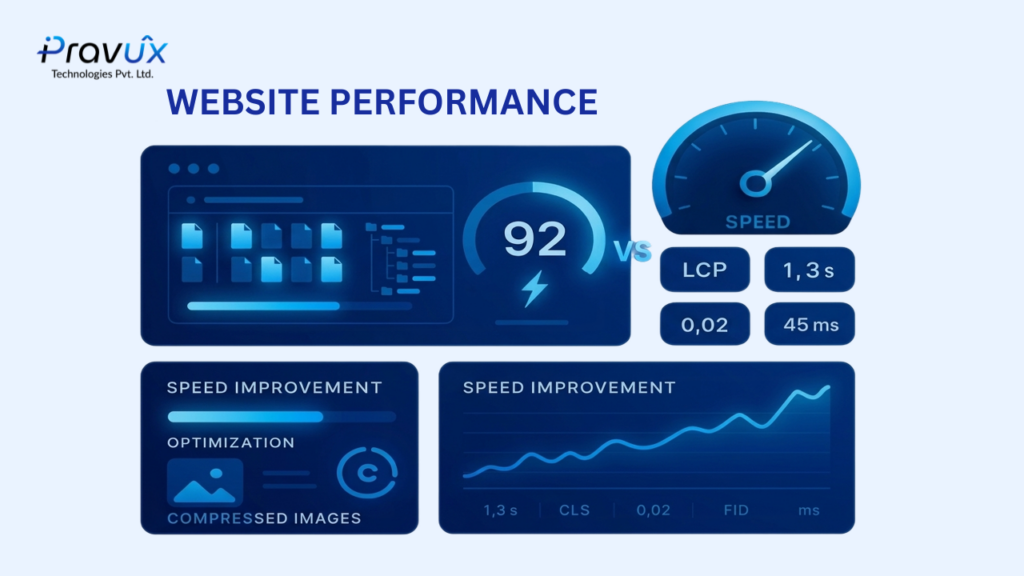
Google’s Core Web Vitals – Largest Contentful Paint (LCP), First Input Delay (FID) / Interaction to Next Paint (INP), and Cumulative Layout Shift (CLS) — have become both a user-experience benchmark and a ranking factor. Next.js is engineered around these metrics rather than treating them as an afterthought.
Automatic image, font, and script optimization
The next/image component automatically resizes, compresses, and lazy-loads images, and reserves layout space to prevent content from jumping around as assets load. next/font eliminates the layout shift and network waterfall traditionally caused by web fonts by self-hosting and inlining font files at build time. next/script gives developers fine-grained control over when third-party scripts execute, keeping the main thread free during the critical loading window.
Why this matters at scale
A typical client-side-rendered SPA has to download, parse, and execute a large JavaScript bundle before the first pixel of real content appears — often producing performance scores in the 60–80 range and noticeable interaction lag on lower-end devices. Because Next.js renders meaningful HTML on the server and hydrates only what’s necessary, applications routinely achieve near-perfect Lighthouse performance scores with minimal main-thread blocking and a visibly more stable layout. This is why Next.js development services consistently deliver superior performance compared to traditional approaches.
3. Developer Experience & File-System Routing
Next.js replaces manually configured routing libraries with a file-system-based router: the folder structure of the project is the routing structure of the application. Creating a new route is as simple as adding a folder and a page file — no route configuration files, no manual path registration.
Nested layouts let shared UI (navigation, sidebars, footers) persist across route changes without re-rendering.
Loading and error states are handled with dedicated files (loading.js, error.js) instead of ad-hoc conditional rendering.
Route groups and parallel routes make it possible to organize complex applications — like dashboards with multiple simultaneous views — without fighting the router.
The result is less boilerplate and fewer decisions to make before a team can start shipping features, which is a major reason Next.js development has become the default choice in bootcamps, coding interviews, and greenfield enterprise projects alike. When you hire dedicated Next.js developers, this streamlined workflow translates directly into faster time-to-market.
4. Full-Stack Capabilities in a Single Codebase
Next.js brings frontend and backend development together in a single codebase through API Routes and Server Actions. Developers can build server-side functionality alongside the UI, reducing API complexity, improving maintainability, and accelerating development for both startups and enterprise applications.
5. SEO and Enterprise-Grade Scalability
Next.js delivers strong SEO by rendering HTML on the server, making content easier for search engines to crawl and index. With built-in support for metadata, sitemaps, and structured data, it’s ideal for content-rich and e-commerce websites. Its flexible deployment options, edge support, and automatic code splitting also ensure fast, scalable performance for modern web applications.
6. Next.js vs. Vanilla React: A Side-by-Side Comparison
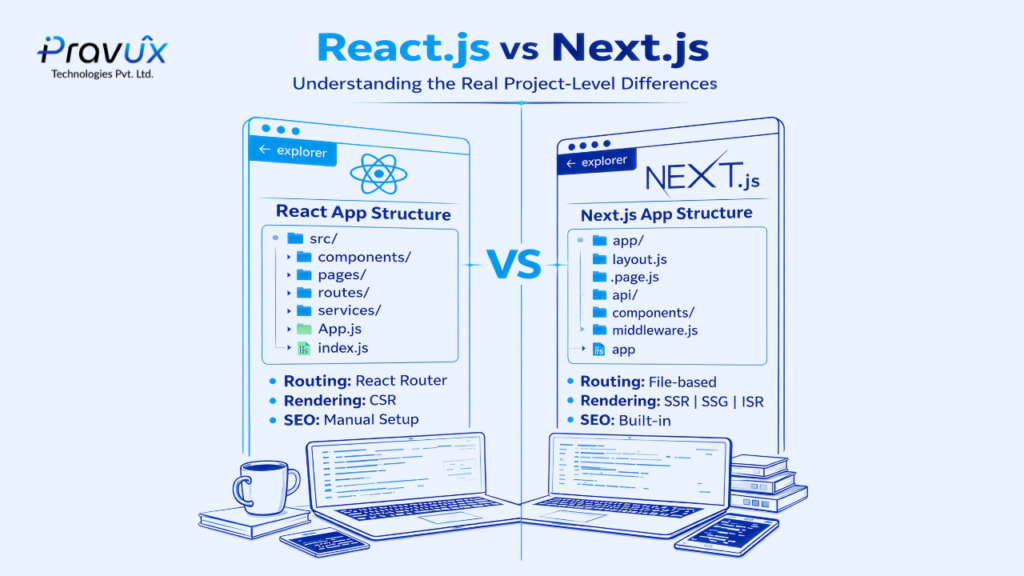
The table below summarizes the practical differences a team encounters when choosing between a hand-assembled React + Vite setup and the Next.js App Router.
Feature | Vanilla React (Vite) | Next.js App Router |
SEO Readiness | Requires complex manual setup | Excellent out of the box |
Routing | Third-party (react-router) | Built-in file-system routing |
Server Components | Not supported | Built-in by default |
Full-Stack API | Requires a separate backend | Built-in API Routes & Server Actions |
Image/Font Optimization | Manual configuration | Automatic (next/image, next/font) |
Deployment | Static hosting only | One-click Vercel or Docker |
7. Real-World Use Cases
Next.js is not tied to a single type of product. Its hybrid rendering model means the same framework can serve very different needs across an organization, which is part of why adoption has spread so quickly beyond the frontend team.
E-commerce platforms: Product listing pages benefit from ISR (fresh inventory without a full rebuild), while checkout flows use SSR for real-time pricing and cart accuracy, all within the same deployment. This is a common requirement for businesses seeking custom Next.js service solutions.
Marketing and content sites: Blogs, landing pages, and documentation sites lean on SSG to serve pre-built HTML from a CDN, achieving near-instant load times with minimal server cost.
SaaS dashboards: Authenticated, data-heavy interfaces use CSR and Server Actions together, keeping the public marketing site fast while the logged-in application stays interactive.
Enterprise portals: Large organizations consolidate what used to be separate frontend and backend repositories into a single Next.js codebase, reducing coordination overhead between teams. This is why many enterprises choose to hire dedicated Next.js developers rather than maintaining multiple technology stacks.
8. Migrating from Vanilla React: What to Expect
Teams moving an existing Vite or Create React App project to Next.js typically encounter three areas of change. First, routing shifts from a library like react-router to the file-system-based App Router, which usually simplifies route definitions but requires restructuring the project’s folder layout. Second, data fetching moves from client-side useEffect calls or a query library toward server components and Server Actions, which can eliminate entire categories of loading-spinner logic. Third, teams need to explicitly mark interactive components with a “use client” directive, since components are treated as server components by default — a mental model shift, but one that pushes JavaScript out of the client bundle by default rather than by manual optimization.
None of these changes require a rewrite. Next.js supports incremental adoption, so a team can migrate route by route while the rest of the application continues running unchanged.
9. Frequently Asked Questions
Is Next.js only for large enterprises?
No. Its zero-configuration defaults and file-system routing make it approachable for solo developers and small projects, while its performance and scalability features are what make it hold up as a product grows. Whether you’re a startup or an enterprise, Next.js development services can scale to meet your needs.
Does Next.js replace the need for a separate backend?
For many applications, yes – API Routes and Server Actions can serve as the entire backend. Larger systems often still pair Next.js with a dedicated backend or microservices, using it as the API layer the frontend consumes. This flexibility is one reason businesses choose to hire Next.js developers in Ahmedabad for full-stack solutions.
Is the learning curve steep for teams already using React?
Most React knowledge transfers directly. The main adjustment is learning the rendering model — understanding when code runs on the server versus the client — which typically takes a few days of hands-on work rather than a lengthy ramp-up.
How do I find the right Next.js development partner?
When evaluating a Next.js web development company in Ahmedabad, look for providers with proven experience in SSR, SSG, ISR, and Server Components. Ask about their portfolio of custom Next.js service projects and their approach to performance optimization and SEO.
Conclusion
React gave the web a better way to build interfaces. Next.js gives that same React a production-ready home — handling rendering strategy, performance optimization, routing, and backend integration as a single, cohesive framework instead of a pile of separate decisions. For developers, that means less time spent on infrastructure and more time spent on product. For enterprises, it means faster load times, stronger SEO, and an architecture that scales from a single landing page to a full commerce platform without a rewrite.
If you’re ready to leverage these advantages for your next project, consider partnering with an experienced Next.js development company in Ahmedabad. Whether you need Next.js development services for a new build or want to hire Next.js developers in Ahmedabad for ongoing support, the right team can help you maximize the framework’s potential. From custom Next.js service implementations to enterprise-scale deployments, the ecosystem is mature enough to support projects of any size.