
Nobody enjoys filling out a form. You click “Get Started,” and suddenly fifteen fields are staring back at you, asking for the same name, email, and phone number you’ve typed in a hundred times before. It’s slow, it’s repetitive, and it doesn’t feel like it belongs in an era where artificial intelligence can write code, summarize a contract, or plan an entire vacation in seconds.
So it’s a fair question: is artificial intelligence finally going to kill off the manual form?
Not exactly. But thanks to tools like the AI powered form builder, the way forms work, and the way engineers build them, is changing faster than most people realize.
Why Traditional Forms Feel So Outdated
Think about the last form you filled out. It probably followed the same tired formula: type your details into a dozen fields, click through a multi-step process, and repeat information you’d already given somewhere else. None of that is hard, exactly. It’s just tedious.
Ask any user why they abandon a form halfway through, and you’ll hear some version of the same complaints:
- It takes too long for something that should be simple
- The process feels unnecessarily complicated
- There’s nothing engaging about typing into empty boxes
Forms get the job done. They just don’t do it in a way anyone enjoys, and that gap between “functional” and “pleasant” is exactly where artificial intelligence has started to step in.
How Artificial Intelligence Is Changing the Way Forms Work
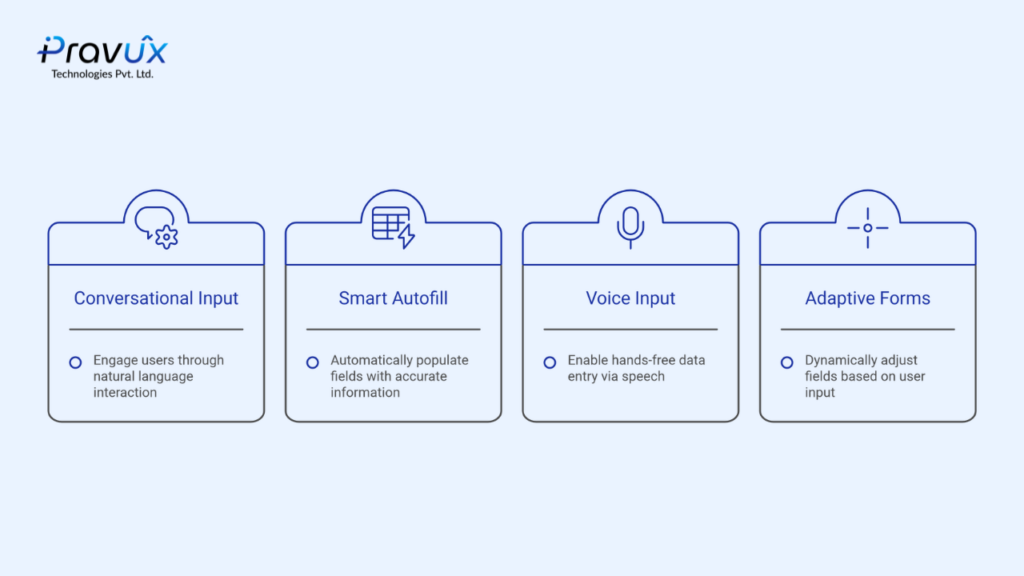
AI isn’t replacing forms outright. It’s quietly rebuilding the experience around them, which matters a lot in modern web development, where user experience directly affects conversions and retention.
1. Conversations Instead of Fields
Picture this: instead of scrolling through a form, you just type or say, “I need a business loan of ₹5 lakh.” That’s the entire input.
From there, an AI system can start a natural back-and-forth, asking only the questions that actually matter, one at a time, in whatever order makes sense. It feels less like paperwork and more like talking to someone who already understands what you need.
2. Smart Autofill and One-Click Actions
What if you didn’t have to type much of anything? This is exactly where an AI powered form builder earns its name. By pulling from previously saved data, learning how a user typically behaves, and recognizing patterns across sessions, these tools can pre-populate most of a form before the user even touches it. Instead of “fill this out,” the experience becomes “just confirm and go.”
3. Voice as an Input Method
Typing isn’t the only way in anymore. Users can simply speak, and AI converts that speech into structured, usable data. For accessibility, and honestly for anyone in a hurry, this removes a huge chunk of friction from the process.
4. Forms That Adapt in Real Time
Old-school forms are static: every field shows up whether it’s relevant or not. AI-driven forms behave differently. They:
- Reveal only the fields that actually apply
- Adjust based on how a user has already answered
- Skip questions that no longer make sense
The result feels lighter, faster, and a lot less like homework.
What This Means for Software Engineering and Software Development Teams
This shift isn’t only a design trend. It’s a real engineering challenge, and it’s changing how teams approach software engineering and software development from the ground up.
Building an AI powered form builder means combining pieces that didn’t always have to talk to each other: natural language processing to interpret what a user actually means, backend logic to map that input to the right fields, and validation systems that still have to catch errors the same way a traditional form would. None of that removes the need for solid software development practices. If anything, it raises the bar, because the system now has to be forgiving enough to handle messy, conversational input while staying strict enough to keep the underlying data clean.
For developers, this means new tools and new habits: APIs that connect AI models to form logic, low-code platforms that let non-engineers configure conversational flows, and a growing expectation that “form building” is now as much about prompt design and data mapping as it is about HTML and CSS. Modern web development increasingly treats the form not as a static piece of markup, but as an intelligent, adaptive layer sitting on top of the same backend systems that have always powered the web.
What Companies Are Actually Doing With This
This isn’t theoretical. Look around and you’ll spot it everywhere:
- Chatbots that gather information through conversation instead of a form
- “Request a Call” buttons that skip forms entirely
- One-click inquiry systems built on saved user data
- AI-driven suggestions that pre-fill details before you even ask
The goal across all of it is the same: cut down how much effort a real person has to put in.
So, Will Manual Forms Disappear Completely?
Realistically, no. Manual forms aren’t going anywhere anytime soon, and there are a few solid reasons why.
AI isn’t practical everywhere. Small businesses, low-budget projects, and simple websites often can’t justify the cost or complexity of building or licensing an AI powered form builder. For a lot of use cases, a plain HTML form is still the smartest, cheapest option.
People still want control. Plenty of users would rather type their own details, double-check every field, and avoid the risk of an autofill mistake slipping through. AI can assist, but it can’t fully replace that instinct to verify things yourself.
HTML is still the foundation. No matter how smart the interface gets, something still has to submit the data, talk to the backend, and handle validation. That’s what forms have always done, and in software engineering terms, that job isn’t disappearing just because the front end got smarter. AI sits on top of that foundation. It doesn’t replace it.
The Real Future Is a Hybrid Experience
The future of forms isn’t about eliminating them. It’s about hiding their complexity behind something that feels effortless.
Here’s what that usually looks like in practice:
- A user starts a conversation with an AI assistant or chatbot
- The AI naturally collects whatever information is needed
- That data quietly fills out the actual form in the background
- The user reviews what’s there and hits submit
From the user’s side, it barely registers as “filling out a form” at all. That’s the whole point.
Final Thoughts
Manual forms aren’t dying. They’re just becoming less visible. Their use is shrinking, their design is getting smarter, and in the best implementations, users barely notice they’re there at all.
That’s the real shift happening across modern web development right now. Soon, fewer people will think, “I need to fill out a form.” They’ll just think, “That was easy,” without ever knowing an AI powered form builder was doing the heavy lifting behind the scenes.