
In today’s digital world, software powers almost every aspect of our lives, from online banking and healthcare systems to e-commerce platforms and mobile applications. Users expect software to be fast, secure, reliable, and easy to use. However, developing software without errors is nearly impossible due to the complexity of modern applications.
This is where software testing plays a crucial role. Software testing is a systematic process of evaluating an application to identify defects, verify requirements, and ensure the product meets quality standards before it is released to users.
Testing is not just about finding bugs; it is about delivering confidence. It helps organizations reduce risks, improve customer satisfaction, and ensure their software performs as intended under different conditions.
In this article, we’ll explore why every software system requires comprehensive quality testing, the risks of releasing untested software, the benefits of a structured quality assurance process, and how modern practices including AI-driven testing are transforming the way organizations deliver high-quality software.
What Is Software Testing?
The test process in software testing involves verifying and validating that a software application works according to its specified requirements. It involves executing the application, identifying defects, and ensuring that all functional and non-functional aspects meet the expected standards.
The primary objectives of software testing are to:
- Verify that the software meets business requirements.
- Detect defects before production.
- Improve product quality.
- Reduce business risks.
- Deliver a reliable and secure application.
Why Is Testing Required?
1. To Ensure Software Quality
Quality is one of the most important factors in software development. A high-quality application should perform correctly, consistently, and reliably across different devices and environments.
Software testing services ensure that every feature behaves as expected and complies with business requirements. Without testing, there is no guarantee that the application will function correctly in real-world scenarios.
Example:
An online shopping application should correctly calculate discounts, taxes, and shipping charges. Testing verifies these calculations before customers use the application.
2. To Detect Defects Early
No software is completely free from defects during development. Coding mistakes, incorrect logic, misunderstood requirements, or integration issues can introduce bugs.
Testing helps identify these defects early, making them easier and less expensive to fix. The later a defect is discovered, the more costly it becomes to resolve.
Benefits of early defect detection include:
- Lower development costs
- Reduced rework
- Faster delivery
- Improved product stability
3. To Verify Business Requirements
A successful application is not defined solely by working code; it must also satisfy business needs.
Testing validates that:
- Functional requirements are correctly implemented.
- Business rules are followed.
- User workflows operate as intended.
- Acceptance criteria are met.
Requirement validation ensures that the delivered product provides the value expected by stakeholders.
4. To Improve User Experience
Users expect applications to be intuitive, responsive, and error-free. Even a minor issue can frustrate users and reduce customer trust.
Testing evaluates:
- Navigation
- Usability
- Accessibility
- Responsiveness
- Overall user interaction
A smooth user experience increases customer satisfaction and encourages long-term product adoption.
5. To Enhance Security
Modern applications handle sensitive information such as:
- Personal data
- Banking information
- Medical records
- Business documents
Security testing identifies vulnerabilities that attackers could exploit.
Testing helps prevent:
- Unauthorized access
- Data breaches
- SQL Injection
- Cross-Site Scripting (XSS)
- Authentication failures
Protecting user data is essential for maintaining trust and meeting regulatory requirements.
6. To Ensure Performance and Scalability
Applications must remain stable under different workloads.
Performance testing measures:
- Response time
- System throughput
- Resource utilization
- Scalability
- Stability under heavy traffic
Example:
During a festive sale, an e-commerce website may receive thousands of users simultaneously. Performance testing ensures the system can handle this traffic without crashing.
7. To Reduce Business Risk
Software failures can have serious consequences, including:
- Financial losses
- Customer dissatisfaction
- Legal penalties
- Brand reputation damage
- Operational downtime
Testing minimizes these risks by identifying issues before deployment.
For industries such as banking, healthcare, aviation, and finance, thorough testing is critical because software failures can directly impact people’s lives and business operations.
8. To Support Agile and DevOps
Modern software development emphasizes frequent releases and continuous delivery.
Testing enables this by:
- Validating every new feature.
- Detecting regressions quickly.
- Supporting Continuous Integration (CI).
- Supporting Continuous Delivery (CD).
- Enabling faster feedback loops.
AI in software testing and automated testing are particularly valuable in Agile and DevOps environments because they allow teams to release software rapidly without compromising quality.
9. To Build Customer Confidence
Customers trust software that performs consistently without unexpected failures.
Well-tested software:
- Reduces production incidents.
- Improves reliability.
- Builds customer loyalty.
- Enhances the organization’s reputation.
Quality software has become a competitive advantage in today’s market.
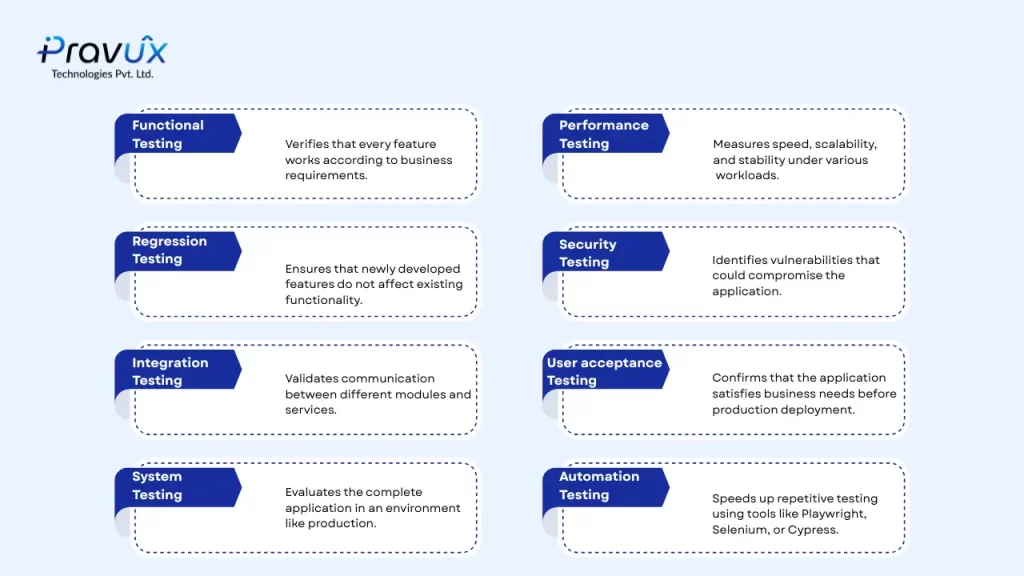
Types of Testing That Help Achieve Quality
Different testing approaches validate different aspects of the application.
Benefits of Software Testing Services
Effective software quality assurance services provide numerous advantages:
- Improves software quality
- Detects defects before production
- Reduces development and maintenance costs
- Enhances customer satisfaction
- Strengthens application security
- Improves system reliability
- Validates business requirements
- Reduces production failures
- Supports faster software releases
- Builds confidence among stakeholders
Best Practices for Effective Software Testing
Organizations can maximize testing effectiveness by following these practices:
Start Testing Early
Early testing helps detect defects before they become expensive to fix.
Understand Requirements Thoroughly
Clear understanding of business requirements leads to better test coverage.
Write Effective Test Cases
Test cases should be simple, reusable, and cover both positive and negative scenarios.
Prioritize High-Risk Areas
Focus testing efforts on business-critical features and high-risk modules.
Combine Manual and Automated Testing
Manual testing is ideal for exploratory and usability testing, while automation improves efficiency for repetitive regression tests.
Perform Continuous Testing
Integrate testing into the development pipeline to receive rapid feedback throughout the software lifecycle.
Track and Analyze Defects
Maintaining defect reports helps teams identify recurring issues and improve overall software quality.
The Cost of Not Testing
Skipping or minimizing testing can lead to significant consequences:
- Increased production defects
- Customer complaints
- Data security breaches
- Revenue loss
- Reduced customer trust
- Emergency hotfixes
- Higher maintenance costs
- Damage to brand reputation
In many cases, fixing a defect after production can cost several times more than resolving it during development.
Conclusion
Software testing is an essential part of software development because it ensures that applications are reliable, secure, efficient, and aligned with business objectives. It is much more than identifying defects; it is a software quality assurance service that protects users, reduces business risks, and improves customer confidence.
As software systems continue to evolve in complexity, organizations cannot afford to overlook testing. By adopting effective testing strategies, businesses can deliver high-quality applications that perform consistently, meet user expectations, and support long-term success.
Ultimately, software testing is not an optional activity; it is a fundamental investment in delivering software that users can trust.
As software continues to evolve with cloud technologies, AI in software testing, agile development, and DevOps, the importance of comprehensive quality assurance will only continue to grow. Organizations that prioritize quality testing are better equipped to release software with confidence, respond quickly to changing market demands, and maintain a competitive advantage.